‘Will AI replace software engineers?’ is a hot topic among software engineers right now, as AI is consistently getting better at various engineering tasks. I know many engineers, both experienced and junior, who are concerned that AI is coming for them.
The short answer is no, but it is already replacing parts of the job. The engineers who thrive will be the ones who shift their focus from tasks AI can handle in minutes to the judgement, ownership and intuition it can’t.
There’s no denying that AI performs many tasks faster than a human can. However, what many engineers don’t realise is that engineering intuition is something you own, and that’s what ultimately makes or breaks your engineering career.
After 16 years in the software field and 5+ years leading remote teams, I keep seeing the same pattern: engineers spend hours sharpening skills that coding agents can now handle in minutes, while neglecting the ones that make them harder to replace.
For IT organisations where AI is heavily involved in daily operations, the responsibility lies in helping engineers understand the transition and encouraging engineering-driven adaptation that adds value to those operations, rather than laying them off.
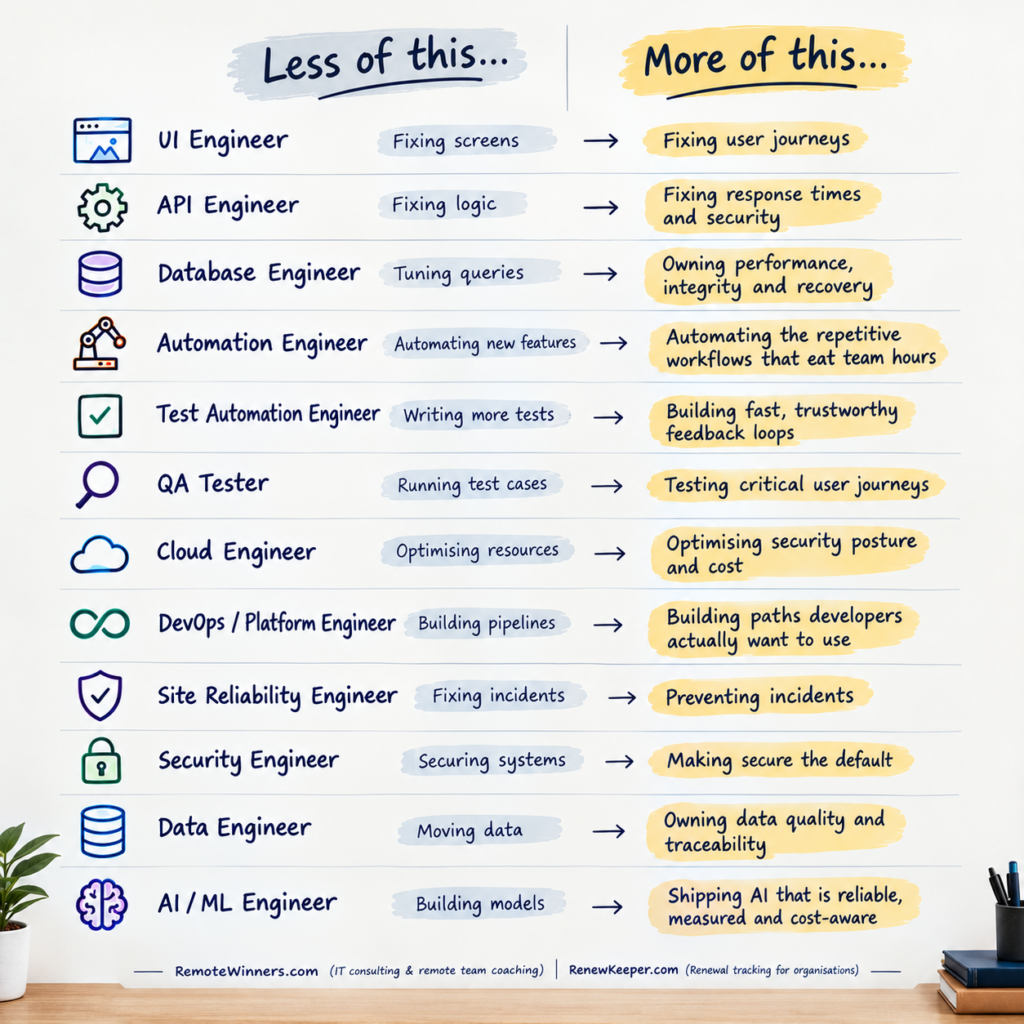
Whether we like it or not, engineering workflows are certainly different to what they were a few years ago. In this post, I’ll discuss the key pivot each software engineering role should make to stay competitive.
🎨 UI engineer
UI engineers are used to building and fixing interactive elements such as forms, tables, wizards and modals in software applications, and they are good at it. Today, AI agents can do the same in a matter of minutes if they are given the right instructions.
Therefore, the focus should shift to thinking like an end user and improving user journeys instead. With your knowledge of front-end frameworks such as Angular, React and Vue, combined with end-user-driven intuition, you are in a much better position to steer the direction of the project’s UI.
⚙️ Back-end engineer
Back-end engineers often find themselves fixing logic, integrating internal and external APIs, communicating with data sources and transforming data for the UI or other consumers. AI can write the same code, often better and much more quickly, when given the right instructions.
Whether you use Java Spring Boot, PHP Laravel or Node.js, where you really stand out is your awareness of security best practices and your performance-driven instinct. Think about how the back end could be exposed to vulnerabilities, and how to cut response times in half. With back-end engineering wisdom grounded in security and performance awareness, your career will thrive in the AI era.
🗄️ Database engineer
Database engineers primarily focus on improving how data is handled within a given database, such as optimising data retrieval and insertion, tuning indexes and designing schemas. Today, various techniques for doing the same, along with their pros and cons, are just a conversation away with your favourite AI tool.
Instead of focusing solely on data interactions and manipulations, you can take ownership of the entire performance, integrity and recovery chain of your database, whether it’s relational or non-relational. Your years of experience with database-driven techniques, paired with that end-to-end ownership, are where your competitive advantage lies in the AI era.
📊 Data engineer
Unlike database engineers, data engineers focus on building scalable data infrastructure and data pipelines. As more and more data tools place agentic AI at the heart of their processes, optimising the various moving parts will increasingly fall to the AI tools themselves.
Instead of focusing on an individual moving part, such as moving data from A to B, think from a business point of view about where your knowledge adds the most value. In my opinion, data quality and traceability are where data engineers can make the biggest difference.
🔁 Automation engineer
Automation engineers spend their time transforming manual, repetitive tasks into workflows that run automatically. Regardless of the tool or platform they use, with the advancement of agentic AI, converting a manual workflow into a testable automated playbook now takes a matter of minutes.
Rather than trying to automate every workflow, a modern automation engineer’s focus should be on identifying which manual workflows eat up the most time in an organisation, and guiding AI agents to automate them with the right testing guardrails.
♾️ DevOps engineer
DevOps engineers systematically connect each stage of the software development lifecycle so that it can run on autopilot with minimal intervention. Over the past few years, this is exactly where AI agents have excelled.
Instead of focusing on building pipelines with platforms such as GitLab CI/CD and GitHub Actions, or infrastructure with IaC tools such as Terraform, focus on building paths that other engineers actually want to use and that save them engineering hours. With your knowledge of the system, its architecture and the business goals, this is where you’ll add the most value alongside AI.
🧪 Test automation engineer
Test automation engineers write code and scripts to programmatically test use cases in software applications. Throw the project specification at any AI agent, and it will generate a full set of test cases in your preferred programming language within minutes.
Instead of writing more and more tests, your focus should be on building fast, trustworthy feedback loops. For example, a failing test should point engineers to the specific root cause and explain why it’s failing in the context of the business goals. This is how you team up with your AI agent.
🔍 QA tester
A QA tester plays a vital role by putting human eyes on the product before real users do. This is often paired with running test cases and evaluating the results. That work is largely deterministic, which makes it exactly the kind of task AI can do faster and more consistently than you.
However, human intuition, such as empathy for users and a knack for spotting confusing flows or unexpected interactions, is one of many valuable traits you’ve developed over years of testing apps. That intuition, paired with AI, is where your competitive advantage lies.
☁️ Cloud engineer
A cloud engineer is responsible for many aspects of cloud operations. These include working closely with various cloud resources and techniques to meet business requirements across software development, infrastructure, networking, storage and more.
AI agents can already provide insightful feedback on optimising cloud resources and operations. As a cloud engineer, your competitive advantage lies in owning the security posture and cost of those resources and operations.
📟 Site reliability engineer (SRE)
A site reliability engineer bridges the gap between software engineering and IT operations to ensure systems are reliable, scalable and available. Fixing incidents and optimising workflows are both areas AI agents will increasingly take on.
As a modern site reliability engineer, your focus should be on preventing incidents, proactively addressing security concerns and ensuring a robust disaster recovery plan is in place.
🔐 Security engineer
In the AI era, if there is one thing to be most cautious about, I would rank security at the top of the list. When security expectations are clear, AI agents are remarkably good at finding vulnerabilities and providing fixes. This is where things get challenging, because the same capability becomes extremely dangerous in the wrong hands.
The security engineer’s role must pivot from securing systems to making ‘secure’ the default. This mainly involves understanding the moving parts that affect security, such as dependencies and third-party integrations further down the chain, and proactively raising the bar for what counts as an acceptable level of security.
🧠 AI / ML engineer
Designing and building intelligent systems to solve real-world problems is where AI/ML engineers’ focus currently lies. Modern AI models already come with much of this built in, from chain-of-thought reasoning and tool use to explainability features and human-in-the-loop controls.
Where AI/ML engineers really make their mark is in designing models that produce reliable, cost-aware output tailored to the consumer. Reliability isn’t a one-size-fits-all metric, so it can be tuned to each use case. However, tuning for reliability shouldn’t send costs through the roof, for example, through excessive reasoning depth or token consumption.
In a nutshell
This post is an attempt to answer some of the concerns many software engineers have about their careers as AI advances. Unquestionably, AI brings a speed that humans simply can’t compete with, whatever their profession.
However, your intuition, shaped by years of experience and trial and error, and inspired by culture, ethics, emotions and moral values, is unique to you and to the role you play. It would be a waste not to make the most of what you’ve got and who you are as a software engineer, in an era where everyone is laser-focused on one question: ‘Will AI replace software engineers?’
If there’s one lesson to take away from this article, it’s how to bring out what’s unique in you, whatever role you play, when the bar is ‘artificially inspired’. That’s where your next career begins 🤗
Ready to make your pivot?
Knowing where your role is heading is one thing. Turning that into a clear plan for your own career is another.
I work one-to-one with software engineers at every level to identify their strengths, sharpen the skills AI can’t replace and map out a practical next step. Whether you’re a junior engineer finding your footing or a senior engineer rethinking your direction, we’ll build a plan that fits you.
👉 Book a career coaching session or explore how I can help.
And if this post sparked a thought, share it with an engineer who’s been asking the same question. 🚀
🔗 Related: Engineering Ownership: What a Two-Year-Old Refactor Ticket Taught Me
📌 Follow Anjana Silva (LinkedIn) for remote work and tech tips for remote startups, tech organisations, and tech professionals.