


Table of Contents
I have been managing remote teams since 2021, but my leadership journey started years before when I unofficially supervised colleagues across multiple roles and continents. Throughout my career, I have had the privilege of managing talented people across continents, learning what truly makes remote teams thrive.
The more I work with remote team members, the more I realise we all share the same fundamental human needs—regardless of our locations, cultures or languages. Now, as AI increasingly enters our workflows, the human element of leadership has become more critical than ever. Remote managers need a clear, structured approach to mentoring that prioritises genuine human connection.
Leadership is about making others better as a result of your presence and making sure that impact lasts in your absence.
Sheryl Sandberg
technology executive, philanthropist and writer
Having worked remotely since 2009 and managed diverse distributed teams for over five years, I have developed a practical framework for mentoring remote employees that actually works. This framework consists of six essential categories: Empower, Check-ins, Goals, Visibility, Teamwork and Feedback. Under each category, I will share six critical practices that form the foundation of successful remote employee mentoring.
1. Empower
- Encourage Autonomy: Encourage autonomy (freedom to decide how and when they work) by providing the required guidance and resources (tools, etc.)
- Foster Task Ownership: Encourage your team to take ownership of tasks (accountability for the outcome of the task).
- Explain the Bigger Picture: Help team members understand the context, the bigger picture, why their work matters and how it connects to company goals, not just the task.
- Publicly Appreciate Achievements: Help the team boost their confidence by appreciating their achievements publicly.
- Support Self-Paced Learning: Allow team members to gain knowledge at their own pace, with frequent check-ins to help them stay on course and navigate through obstacles.
- Lead with Empathy: Empower through empathy and lead by example.
2. Check-ins
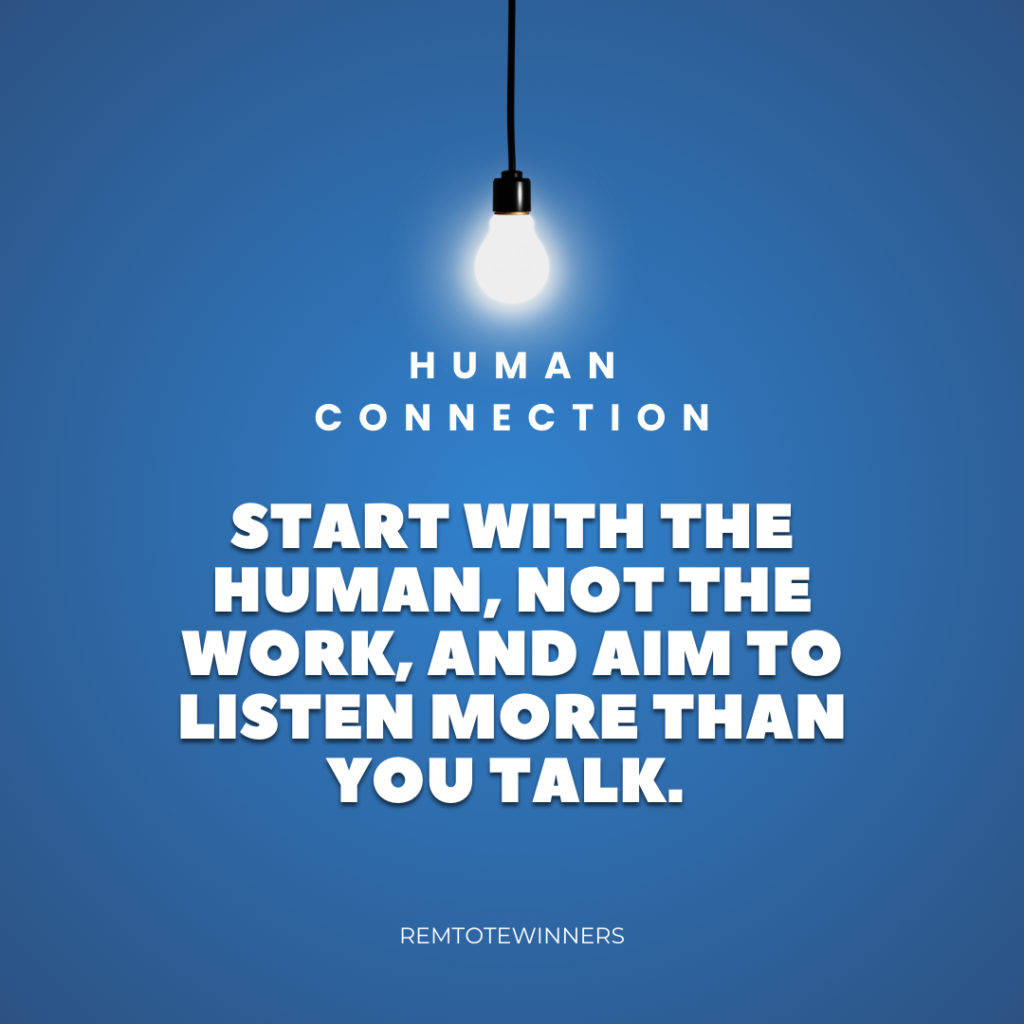
- Prioritise Human Connection: Start with the human, not the work, and aim to listen more than you talk. Don’t jump straight into status updates; instead, form a human connection first.
- Show Genuine Care: Share your genuine interest by asking questions related to their physical and mental health. Ask about their relatives and loved ones, too. Help them or guide them towards help using your best judgment.
- Check In Supportively: Engage in non-invasive and non-micromanaging check-ins to help your team boost their productivity whilst maintaining a healthy work-life balance.
- Guide Course Corrections: Offer support for course correction to help your team stay on course. Remember to share the key lessons you’ve learnt with your team.
- Address Concerns Promptly: Address concerns proactively or as and when they arise instead of waiting for the scheduled formal meeting slot. Otherwise, bottling up emotions can lead to a mental breakdown.
- Use Video When Possible: During check-ins, encourage using video calls to understand their facial expressions and body language better.
3. Goals
- Support Career Advancement: Help your team achieve career-related goals which are directly related to the advancement of their career within your organisation.
- Encourage Personal Interests: Also, help your team achieve career-related initiatives which are of their personal interest, not directly related to the role they are playing in your organisation (e.g., be good at a sport, write a book or start a business).
- Help Discover Goals: Reassure team members that it’s okay not to have a goal defined. However, don’t stop there; help them discover their own goals, because they might not know there may be goals in their subconscious mind that they are unaware of.
- Share Your Experience: Share your goals, knowledge and experience with your team members to help them discover/inspire their goals. Don’t underestimate the power of your hard-earned knowledge and experience and the impact it can make on others’ success.
- Create Actionable Plans: Help them build a strategic, actionable plan by following frameworks such as SMART (Specific, Measurable, Achievable, Relevant and Time-bound), OKR (Objectives and Key Results) or MBOs (Management by Objectives) to achieve their goals.
- Celebrate Progress Too: Finally, do not forget to celebrate the progress, not just the completion.
4. Visibility
- Showcase Team Contributions: Showcase your team members’ contributions within your team and outside the team (e.g., all-hands meeting) frequently.
- Build Professional Portfolios: Help your team build a portfolio to showcase their work (e.g., GitHub repo to demonstrate their coding work, blog to share their writing and ideas, etc.), in line with their career and personal goals.
- Use Async Communication Strategically: Help your team use asynchronous communication methods strategically, such as end-of-day summaries, weekly progress notes or recorded video updates, to improve their visibility.
- Prioritise Actionable Visibility: Help your team gain trust through actionable visibility (e.g., task completion, documents written, etc.) rather than the hours they stayed online.
- Share Work-in-Progress Updates: Encourage team members to share their thinking process, not just finished work. Quick updates in the group chat channels about what they’re working on, blockers they’ve hit or decisions they’re considering create ambient awareness that replaces the visibility you’d naturally have in an office.
- Foster Informal Connections: Visibility isn’t just about work output. Create informal connection opportunities such as virtual coffee chats, team channels for non-work chats, or to share photos/videos taken during holidays.
5. Teamwork
- Build Team Belonging: Help your team understand the importance of teamwork and the sense of belonging to a team.
- Implement Buddy Systems: Pair up your team member with another colleague to improve collaboration and informal mutual support (e.g., buddy system).
- Encourage Open Discussion: Encourage discussing problems openly and honestly in a team setup. Don’t judge them for doing so.
- Seek Team Consensus: Lead with consensus. Listen to your team’s feedback and always strive to seek consensus in decision-making.
- Enable Cross-Functional Exposure: Encourage cross-functional exposure to get involved in tasks or projects that involve knowledge-sharing amongst different team units.
- Promote Empathy-Driven Culture: Promote empathy-driven teamwork. Help your team understand other team members better, which promotes an empathetic culture amongst your team members.
6. Feedback
- Give Specific, Actionable Feedback: Provide specific and actionable feedback that aims to improve your team member’s performance and also aligns with their strategic goals (work or non-work).
- Provide Timely Feedback: Provide on-the-spot feedback and encourage your team to do the same, instead of waiting for the formal review slot.
- Choose Appropriate Medium: Feedback can be given over a call or asynchronously via your standard chat application. However, when giving feedback on sensitive topics, always use video so that you can read others’ facial expressions and their body language.
- Reassure Before Constructive Feedback: Remote team members can feel isolated and may worry more about job security. Before diving into constructive feedback, ensure they know you’re invested in their growth.
- Encourage Two-Way Feedback: Regularly ask your team how you can support them better. This normalises feedback as a two-way street rather than something that only flows downward.
- Document Key Points: After feedback conversations, send a brief written summary of key points and any agreed-upon action items. This ensures alignment and gives your team members something to reference later.
In a Nutshell
Mentoring remote employees requires a fundamentally different approach than managing in-office teams. The difference between accelerating your team’s growth and inadvertently holding them back often comes down to having the right framework.
This framework gives you 36 specific practices across six core categories: Empower, Check-ins, Goals, Visibility, Teamwork and Feedback. Each one puts human connection first, whilst giving you the structure needed to mentor confidently across time zones and cultures.
Which area will you focus on first with your team? Let me know in the comments.
📄 I’ve created a simple guide: 7 ways to truly connect with your remote team, which you will find useful.
🎯 Need Expert Help?
If you’re facing challenges with remote work, I offer 1:1 coaching and tailored support to help you succeed at remote setup. Whether you’re just starting out, growing as a remote contributor, leading a team, or launching a remote-first start-up, Remote Winners offers targeted 1:1 coaching to help you thrive in a distributed world. We also provide tech consultancy services—from idea-to-product guidance to cloud deployment and cybersecurity reviews—to help organisations strengthen their technology and processes.
If you are unsure where to begin, drop us a message and we’ll be in touch.


