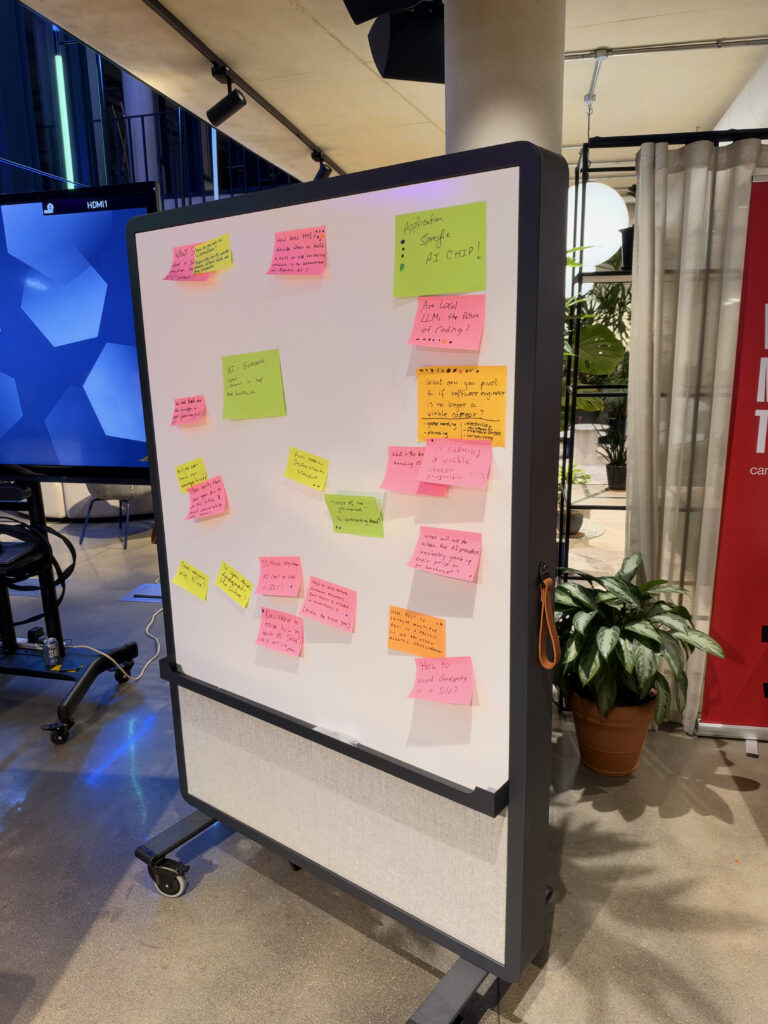
Recently, I attended an open-format tech meetup organised by Software Crafters Cambridge1. There was no fixed agenda. Attendees wrote the topics they wanted to discuss on sticky notes, stuck them on whiteboards, and the most voted topics became roundtable topics.
My note was the pink one, top middle: how should SMEs decide when to build a tool versus using an existing product in the advancement of agentic AI? It got enough votes to make the cut, and I’ll admit I was quietly chuffed 😄
Here’s why I think it matters. Agentic AI is advancing fast, and AI agents can now plan and carry out multi-step tasks, including writing large chunks of working code. So an SME with a couple of engineers can build in days a tool it would once have paid a subscription for. Internal dashboards, CRMs, scheduling tools, reporting pipelines: suddenly they all look buildable.
At the same time, the products you’d buy are getting smarter, with vendors racing to build AI agents into their software. The classic build vs buy software decision is being rewritten at a rapid pace from both sides.
However, here’s the catch. Agentic AI has made building significantly cheaper, although it hasn’t quite made owning cheaper. The prototype is the easy part and we all know it. Running it reliably, securely and affordably for the next three years is the hard part.
Below are the 10 questions I’d want any SME to answer before deciding whether to build in-house or buy. The first five came straight out of the roundtable. The other five add more to the debate, drawing on the knowledge I’ve gathered over 16 years in the software industry, leading remote engineering teams and advising founders on technology decisions.
The five questions from the roundtable
1. Is this tool part of your core strength?
If the tool sits right at the heart of what your business does best, building can make sense. It might even become a competitive advantage. A payments business building its own fraud-detection tooling is playing to its strengths. A marketing agency building its own HR system probably isn’t, even if an AI agent could write the first version over a weekend.
A quick test: if a competitor bought the same off-the-shelf tool tomorrow, would it hurt you? If not, it’s probably not core, and the case for building gets much weaker.
2. Can you maintain it for years, not months?
Shipping version one is the start, not the finish. Someone has to patch it, upgrade dependencies, run vulnerability scans and fix it when it breaks at 3 am.
Agentic AI adds a twist here. An AI agent can write the code quickly, but someone on your team still needs to understand it well enough to own it. Code nobody fully understands becomes a liability the moment it breaks or a security issue flags up.
And if the tool itself uses AI models, those get deprecated and change behaviour too. Do you have the people and the cash to keep on top of all this in year two, three and four?
📌 Related post: 5 App Maintenance Strategies for Non-Technical Founders
3. How does the licence cost compare with building it?
Run the numbers as a starting point. Let’s assume your SME has 10 users and an existing tool costs £20 per seat per month. That’s £2,400 a year.
Now picture two engineers building and maintaining an alternative. At an illustrative £60,000 a year each, once you add employer NI, pension and kit, that’s £120,000 a year. You’d need to pay for the off-the-shelf tool for 50 years to match one year of the build. Even at a quarter of their time, you’re looking at £30,000 a year against £2,400.
Agentic AI does change one part of this sum: the initial build can be much quicker. It rarely shrinks the maintenance, though, and that’s where most of the cost sits.
Building tends to win on cost only when licences get big: lots of seats, or usage-based pricing that climbs fast as you scale. Many AI-powered products now charge per task or per action, so model the cost at three times your current volume before you decide.
📌 Related post: The 5 Signs Your SME Is Not Ready for AI Yet
4. Will building it create compliance problems later?
When you build, you own the compliance burden. If you handle personal data, payment data, or work in a regulated sector, your homegrown tool lands inside your audit scope. That means access controls, logging, data retention and being able to show who accessed what and when.
A mature vendor may already hold certifications you’d spend months chasing. Then again, a vendor might not meet your requirements, which can be a genuine reason to build. Either way, AI regulation is still moving. A tool that’s compliant today may need changes tomorrow, so ask who will make them.
5. Is this the best use of your team’s time?
Every hour your engineers spend building and looking after an internal tool is an hour they’re not spending on the product or service that pays the bills. For an SME, focus is the vital resource you have.
Ask yourself: if we put the same effort into our core product, what revenue could it generate? Opportunity cost rarely shows up in the spreadsheet, but it’s often the highest cost of all.
Five more questions I’d add
6. How quickly do you need results?
Agentic AI has made building faster, but a working demo is not a production tool. Buying can still get you dependable value this week, while building something robust usually takes months.
Agentic AI is moving so fast that by the time your in-house tool is ready, a vendor may have shipped the same capability as a standard feature. AI-powered products are improving month by month, and yours would need to keep pace. If speed matters, buy first and learn what you actually need.
7. Where does your data go, and who or what can act on it?
As vendors build AI agents into their products, those products don’t just store your data. They leverage your data, for example, sending emails, updating records and calling other systems. So data and permissions matter more than ever.
Before buying, ask: where is our data processed and stored? Is it used to train the vendor’s models? Can we control exactly what the agent can access and do? Is there an audit trail? Before building, ask whether you have the security expertise to get those guardrails right yourself, including a proper review of any code an AI agent wrote for you.
It’s no coincidence AI governance and keeping a human in the loop had their own sticky note on the same board (One on the green, below my note in pink).
8. What happens if your vendor raises prices or disappears?
Another note on that whiteboard (the pink note, 3rd from the bottom, on the rightmost column) asked what we’ll do when AI providers inevitably put their prices up or go bust. Brilliant question, and it applies whether you build or buy.
If you buy, check whether you can export your data, workflows and prompts, and whether a realistic alternative exists. If you build, you may still depend on AI providers, for the coding tools your team relies on or for AI features inside the tool. Design it so you can swap providers without a rewrite. Lock-in is a risk either way. The real question is how painful it would be to leave.
9. Will it actually fit how your team works?
A tool is only as useful as the systems it connects to. If it can’t talk to your CRM, ticketing system, shared drive or finance tools, it becomes another tab nobody opens.
Check integrations before features. More products now support open standards such as the Model Context Protocol (MCP), which let AI agents work across the products you buy. That makes buying more flexible than it used to be. If the integrations you need don’t exist and never will, that’s a genuine argument for building. And whichever way you go, ask whether your team will actually use it 😅
10. Is there a middle path?
Build vs buy is rarely a straight question to ask. Often the smartest move is to buy a platform, then configure and extend it. Let the vendor handle the heavy lifting and build only the thin layer that’s unique to your business.
Another option is to start with an off-the-shelf tool, prove the value and learn your real requirements. Build only once you’ve genuinely outgrown it. This keeps your decisions reversible, and for an SME that’s gold.
Build vs buy software: A quick rule of thumb
If you only remember one thing from this post, make it this.
👷 Lean towards building when:
- The tool is directly tied to your core strength
- No existing product does what you need
- You have the people and budget to maintain it for years
- Your data or compliance needs rule out the vendors on the market
💰 Lean towards buying when:
- It supports your business rather than defines it
- You need results quickly
- Licence costs are modest compared with engineering time
- A mature vendor already handles security, compliance and integrations
And whatever you do, don’t build something just because an AI agent makes it feel quick.
The real lesson
What struck me most at the roundtable was that nobody argued building is wrong or buying is lazy. The right answer depends on the SME: its strengths, its budget and its appetite for owning something long term.
As agentic AI advances, the mistake is deciding because building suddenly feels quick and exciting, or because a vendor demo looked slick. Answer these 10 questions honestly and the right call usually becomes obvious.
FAQ
Has agentic AI made it cheaper for SMEs to build their own tools?
It has made the first build faster and cheaper. It hasn’t removed the cost of maintaining, securing and supporting a tool for years, which is where most of the cost sits.
Should SMEs build or buy software now that AI can write code?
Most SMEs should still buy for supporting functions. Build only when the tool is core to your competitive advantage, no suitable product exists, and you can afford to own it long term.
How do you compare the cost of building and buying a tool?
Compare the annual licence cost with the full cost of engineering time to build and maintain the tool. Include upgrades, security and the opportunity cost of not working on your core product.
What are the hidden costs of building tools with AI?
Ongoing maintenance, reviewing and understanding AI-written code, security patching, compliance work, changes to the AI models you rely on, and engineering time taken away from revenue-generating work.
How can SMEs avoid vendor lock-in?
Check data export options before you sign, favour tools that support open standards, keep your workflows documented in-house, and design any custom build so you can swap providers.
Need a second opinion on your build vs buy decision?
Weighing up whether to build a tool or buy one, now that agentic AI makes building look easy? I help founders and SMEs make technology decisions like this through fractional CTO and technology strategy support.
👋 Explore my services or get in touch for a chat.
🔗 Check out my other articles on 5 Engineer Hiring Strategies for Non-Technical Founders, 5 App Testing Strategies for Non-Technical Founders, 5 UX Strategies for Non-Technical Founders, 5 Database Strategies for Non-Technical Founders and 5 Tech Stack Strategies for Non-Technical Founders.
📌 Follow Anjana Silva (LinkedIn) for remote team building and tech tips for remote startups.
♻️ Share this with your founder friend.