What taking ownership at work really means: 10 habits that build trust
Introduction
Taking ownership at work doesn’t mean doing everything yourself. It means taking responsibility for the outcome, from beginning to end.
You can be a strong communicator. You can be technically excellent. You can be a great team player with slick presentation skills. But if people can’t rely on you to carry something through, all of those skills will have less impact.
In my 16-year tech career, including over 5 years leading software engineers, I have witnessed first-hand how a lack of ownership stalls one’s career. Ownership is the quiet skill that ties the rest together. It’s also one of the clearest signals of who’s ready for more responsibility. Here are 10 habits that show what taking ownership at work looks like in practice.
1. Be strategic up front
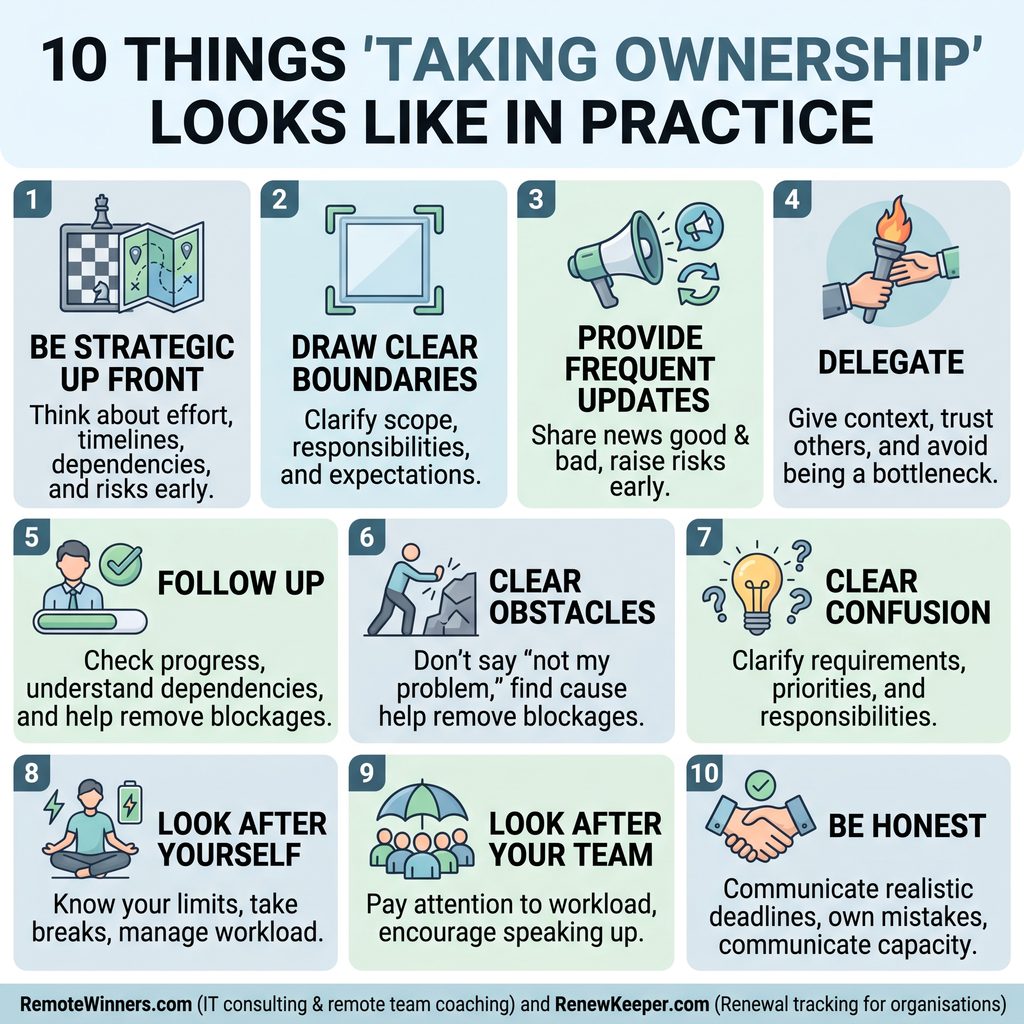
Before you start, think beyond the task itself. How much effort will it take? How long? Who else needs to be involved? What dependencies exist, and what could go wrong? A few minutes of thinking upfront can save hours of wasted effort later.
2. Draw clear boundaries
Be explicit about what’s included, what isn’t, and what people should expect. Ambiguity creates unnecessary work. Clear boundaries help everyone understand responsibilities, timelines and expectations.
3. Provide frequent updates
Don’t wait for someone to ask, “How’s it going?” Share progress when things are on track, share concerns when they aren’t, and raise risks early. Bad news delivered early is almost always easier to deal with than bad news discovered at the deadline. I learned this myself back in school: saying up front, unasked, that I hadn’t finished yesterday’s take-home assignment saved me so much hassle.
4. Delegate when appropriate
Ownership doesn’t mean becoming the bottleneck. If someone else has the right skills or capacity to handle part of the work, hand it over. Give them the context and trust them to deliver. Helping others contribute is part of owning the overall outcome.
5. Follow up
Delegating isn’t the same as disappearing. Check in, understand progress, offer help where needed and make sure dependencies keep moving. Good ownership means knowing what’s happening without micromanaging how everyone works.
6. Clear obstacles
If something is blocking you or your team, don’t ignore it as someone else’s problem. Find the cause, talk to the right people, escalate when necessary and remove whatever you reasonably can. Sometimes ownership is less about doing the work and more about making the work possible.
7. Clear confusion
Confusion is an invisible productivity killer. If people aren’t sure about the requirement, the priority, the responsibility or the expected outcome, stop and clarify it. Don’t let uncertainty quietly turn into delays, rework and frustration.
8. Take responsibility for your own health
You can’t sustainably own outcomes if you keep running yourself into the ground. Know your limits, take breaks, manage your workload and ask for help when you need it. Recognising that you’re approaching burnout isn’t a weakness. Ignoring it until your health and performance suffer isn’t showcasing your ownership skills.
9. Look after your team
Ownership also means treating your team as people, not resources. Pay attention to workload, pressure and changes in behaviour. Create space for people to speak up and support reasonable boundaries. You don’t need to be anyone’s therapist, but you can build an environment where people feel safe asking for help.
10. Be honest
Perhaps the most important one. Don’t say “yes” just because “no” feels uncomfortable. If a deadline isn’t realistic, say so. If you don’t have the capacity, communicate it. If you made a mistake, own it. People don’t expect everything to go perfectly. Because the world itself isn’t a 100% perfect place. People around you need to know they can trust you to tell them what’s actually happening.
In a nutshell
Taking ownership at work isn’t about having all the answers, doing everything yourself, or working longer hours to prove your commitment. It’s about being someone others can rely on to move things forward, communicate honestly, manage risks, remove obstacles and take responsibility for the outcome.
The 10 habits at a glance:
- Be strategic up front
- Draw clear boundaries
- Provide frequent updates
- Delegate when appropriate
- Follow up
- Clear obstacles
- Clear confusion
- Take responsibility for your own health
- Look after your team
- Be honest
Your job title tells people what your role is. Your ownership shows them what they can trust you with. Over time, that reliability becomes visible, and that’s where ownership starts contributing to progress, recognition and career growth.
Want to build the habits that get you noticed and promoted? I coach engineers and remote professionals on exactly this. Explore coaching and consulting or get in touch to talk it through.
🔗 Related: 11 Simple Ways to Recognise Remote Employees and Make Them Feel Valued
📌 Follow Anjana Silva (LinkedIn) for remote work and tech tips for remote startups, tech organisations, and tech professionals.