Introduction
After 16 years in software engineering, one thing I’ve learned is this: good engineers write code. Great engineers, whether they use AI or not, understand the principles behind the code.
The latest Stack Overflow developer survey1 data backs that up. AI is now part of almost every developer’s day-to-day activity. Agents are spreading at a constant speed, yet the trust in what these tools produce is going down, not up.
That gap tells us a real story. When a machine can generate the code, the value moves to the person who can judge it. Below, I break down 10 findings that matter for software teams, what they mean for the human in the loop, and how to stay ahead as agent-assisted engineering becomes normal.
Why the human in the loop still matters
The survey makes one thing clear: developers still want a human doing the final verification. Asked to imagine a future where AI handles most coding, 75% said they would still turn to a person because they don’t trust AI’s answers. 62% pointed to ethical or security concerns.
That human needs to know what good looks like. Spotting a subtle race condition, an insecure code block, or a design that won’t scale takes real understanding of the software life cycle. Prompting skill alone won’t get you there.
This is where the gap between engineers widens. An engineer who understands requirements, design, testing, security and operations will always outsmart a mediocre engineer with the same AI tools. The tools amplify judgement. They don’t replace it.
10 findings from the Stack Overflow developer survey
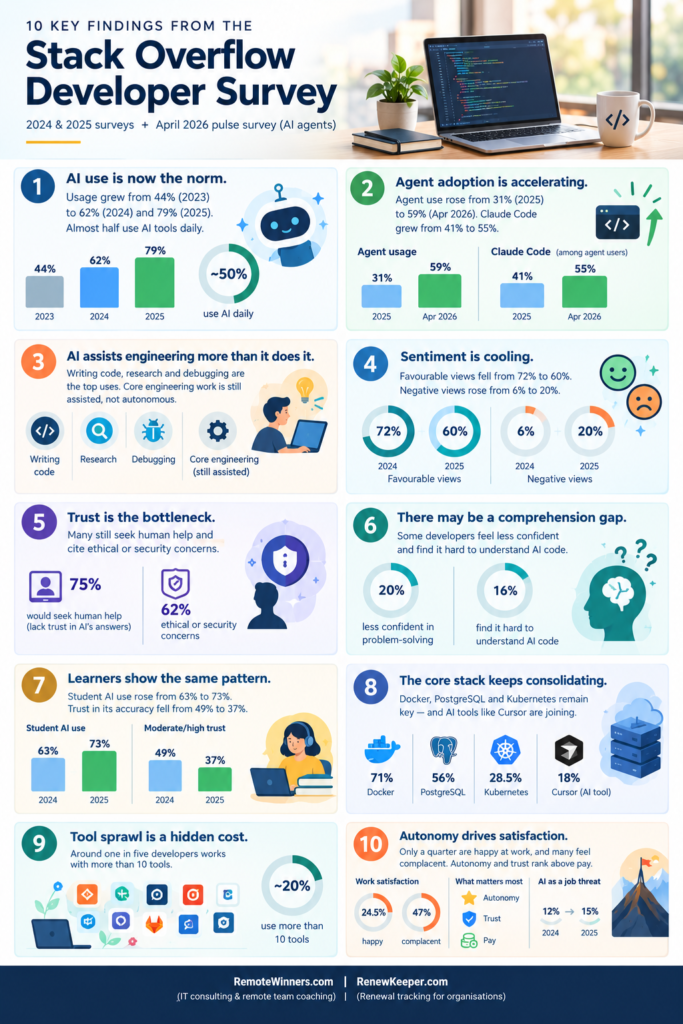
These figures compare the 2024 and 2025 surveys, plus an April 2026 pulse survey on AI agents.
- AI use is now the norm. Usage grew from 44% in 2023 to 62% in 2024 and 79% in 2025. Almost half of developers use AI tools every day.
- Agent adoption is accelerating. Agent use rose from 31% in 2025 to 59% in the April 2026 pulse survey. Claude Code usage among agent users climbed from 41% to 55%.
- AI assists engineering more than it does it. Writing code, research and debugging are the most common uses. Core engineering work is still assisted rather than autonomous.
- Sentiment is cooling. Favourable views of AI fell from 72% to about 60%. Negative views jumped from 6% to 20%.
- Trust is the bottleneck. 75% would still seek human help because they don’t trust AI’s answers. 62% cite ethical or security concerns.
- There may be a comprehension gap. 20% feel less confident in their own problem-solving. 16% find it hard to understand how or why AI-generated code works.
- Learners show the same pattern. Student AI use rose from 63% to 73%. Their moderate or high trust in its accuracy fell from 49% to 37%.
- The core stack keeps consolidating. Docker sits at 71%, PostgreSQL at 56%, Kubernetes at 28.5%, and Terraform at 18%. AI tools like Cursor (18%) are also joining this stack, instead of replacing it.
- Tool sprawl is a hidden cost. Around one in five developers works across more than 10 tools. That means constant context switching and maintenance overhead.
- Autonomy drives satisfaction. Only 24.5% of developers say they are happy at work, and 47% feel complacent. Autonomy and trust rank above pay. Concern about AI as a job threat rose from 12% to 15%.
How to stay ahead of agent-assisted engineering
Agents will write more and more of the code, which is a fact you have to admit (& welcome). Your competitive edge is how you will navigate this agent-assisted engineering wave. Here’s where I’d focus.
- Master the fundamentals. Data structures, design patterns, concurrency and system design don’t go out of date. They are how you distinguish an accurate output from an output that just looks good on paper.
- Own the full life cycle. Requirements, architecture, testing, release and operations. Agents work task by task; engineers who see the whole system make the more informed & accurate decisions.
- Make verification a discipline. Treat AI output like a pull request from a new joiner. Review it, test it and never merge code you can’t explain.
- Write better specs. Agents are only as good as the instructions they get. Clear acceptance criteria and constraints save hours of rework.
- Build security in by default. Check dependencies, secrets handling and input validation on every AI-generated change. Security is where blind trust can cost you the most.
- Set guardrails for your team. Agree where agents can act alone, where they need sign-off and who owns the result. Monitored autonomy always beats the speedy output that was never checked.
- Keep learning from people. Mentors, code reviews and communities teach the why behind the code. That is exactly what AI struggles to give you.
In a nutshell
AI and agent use is rising fast, but developers’ trust in what these tools produce is falling, and most still want a human doing the final verification. That human has to understand the principles behind the code, not just the prompt that generated it. Strong fundamentals and full life-cycle thinking are now the biggest differentiators, and teams that pair AI speed with human judgement and clear guardrails will come out ahead. AI won’t replace great engineers. It will expose the difference between good and great.
Ready to build an AI-ready engineering team?
Whether you’re leading a team adopting AI agents or growing your own engineering career, I can help. Explore RemoteWinners services.
🔗 Related: 78 Software Design Principles Every Engineer Should Know (and Every CTO Should Champion)
📌 Follow Anjana Silva (LinkedIn) for remote work and tech tips for remote startups, tech organisations, and tech professionals.