Intro
In my 15+ years in software engineering, with more than half of that spent mentoring engineers, one simple yet often-overlooked factor rarely comes up in conversations about improving team performance.
At IBM TechXchange 2025 in Florida, I connected with someone who leads remote teams, and we got into a conversation about the key things to consider when managing people remotely. One topic that sparked real curiosity for me was understanding your remote team’s peak performance hours and scheduling deep-focus work around them.
Remote team peak performance hours are the specific windows in a person’s day when their concentration, energy, and output are naturally at their highest. Each of us has different hours during the day when our focus is at its peak. For me personally, that’s usually in the morning (7am–11am) and again in the late afternoon (4pm–7pm). Peak hours vary by day, week, and personal factors such as lifestyle, family commitments, and chronotype.
From a leadership perspective, understanding your remote team’s peak performance hours helps you schedule collaborative sessions when energy is naturally high. Equally importantly, you can use that knowledge to help your team protect those core hours for uninterrupted deep-focus work.
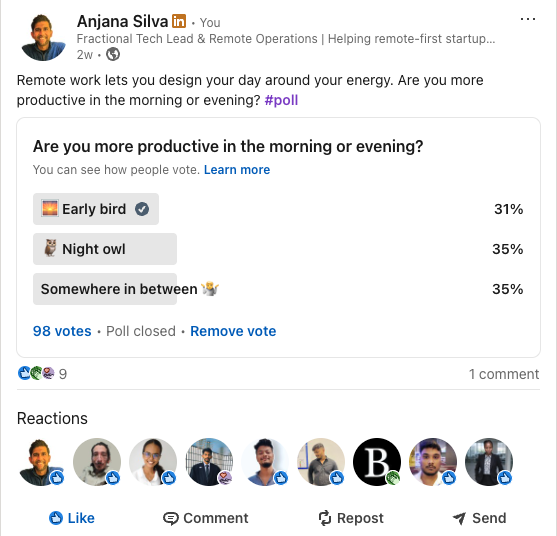
Are You More Productive in the Morning or Evening? – Poll
To explore this further, I ran a poll on LinkedIn a few weeks ago to see when my network feels most productive. Sure enough, there’s no one-size-fits-all answer. Different people have different peak hours, and in my poll, responses were almost equally distributed across the options.
I reached out to some of the participants to dig a little deeper into how they actually spend their focused hours.
Martin Dutnell (Business Analyst with 20+ years of SDLC experience), working from home since March 2020.

Peak focus hits in the morning, and that time is reserved for tasks that are the highest priority on that day. Rather than following a fixed task hierarchy, priorities shift from project to project, with one consistent anchor: creating a to-do list before finishing for the day for the next day. When focus drifts, breaks are spontaneous rather than scheduled, ranging from five minutes to make a coffee to fifteen or twenty minutes to feed the dogs or simply wind down. More often than not, those breaks naturally align with the end of a task or a meeting.
Ransilu Ranasinghe (AI/ML & Backend Engineering | Computer Science (AI) Undergraduate)

Peak focus naturally falls in the morning and evening, and time is often spent balancing university assignments and personal projects. During those windows, the priority is hands-on programming and software engineering work, tasks that often involve problem-solving and brainstorming. When focus starts to drift, stepping away for a short break is the go-to reset.
Nadeeshan Dangalla (Backend Engineer), fully remote since 2024.

Peak focus is in the afternoon, and brainstorming takes centre stage during that time. Brainstorming sessions involve a few people and often fit within the productive window, which will be around 80% of the time. When focus starts to slip, the approach is not one long break but a series of short breaks scattered between the main ones.
Exploring the responses reveals that peak performance is personal; no two people share the same productive window. That said, a few clear patterns emerge. Regardless of whether focus peaks in the morning, afternoon, or evening, the instinct is the same: protect that time for the most cognitively demanding work, whether that is programming, high-priority tasks, or brainstorming. Break strategies differ in style, ranging from a spontaneous coffee to a series of short resets, but they all serve the same purpose: recovering focus before it slips too far.
What This Means for Remote Leaders
As a remote leader who is aiming for peak team performance, here are a few practical steps worth considering.
- Run a quick survey to find out when each person does their best work. Peak hours vary more than most leaders assume, and simply asking the question opens up a valuable conversation.
- When scheduling brainstorming sessions, aim for windows where the most team members are at their peak. Not every session will land perfectly for everyone, but being mindful of it makes a difference.
- Encourage your team to block at least 80% of their peak window for deep-focus work, leaving the remaining 20% as a buffer for collaboration and brainstorming when needed.
- Reassure your team that it is okay to set their status to “do not disturb” during peak hours. Removing the pressure of appearing constantly available is often what allows focused work to actually happen.
- Lead by example. Share your own peak hours with the team. It normalises the conversation and makes it easier for others to do the same.
- Revisit this periodically. Peak hours are not fixed. They shift with seasons, life changes, and workload, so a quick check-in every few months keeps the picture accurate.
- Be mindful of recurring meetings. Daily standups or weekly syncs are often scheduled out of habit rather than intention. If those meetings consistently land during someone’s peak window, they are quietly eroding that person’s most productive time without anyone realising it.
- Where possible, encourage an async-first culture where not every message needs an immediate response. This reinforces the protection of peak hours without requiring constant calendar management.
📌 Want to Get More Out of Your Remote Team?
If you are leading a remote team and looking for practical ways to improve performance, protect focused time, and build a culture where your team does their best work, you do not have to figure it all out alone.
Through my coaching at Remote Winners, I work with remote leaders to:
- Understand and align around their team’s working styles and peak performance hours
- Build practical strategies that protect deep-focus time
- Create an environment where remote teams thrive, not just function
- Develop leadership habits that drive real, measurable results
If that sounds like something you need, you can explore more on my Coaching page.
Let’s work together to bring out the best in your team.
In a Nutshell
Understanding your remote team’s peak performance hours is one of the simplest yet most overlooked facts a leader can use to improve team performance. There is no universal window; morning, afternoon, and evening all have their peak performers. However, the goal across the board is the same, which is to protect that time for the work that matters most.
As a remote leader, your role is not to dictate when people work, but to create the conditions where your team can do their best work. That starts with asking the right questions, being mindful of how meetings and messages eat into focused time, and leading by example. Small shifts in awareness can make a significant difference not just in output, but in how your team feels about the way they work.