Introduction
After 16 years in software engineering, one thing I’ve learned is that good engineers write code. Great engineers, whether they use AI or not, understand the principles behind the code.
Frameworks come and go. Languages rise and fall. AI tools can now generate a working function in seconds. But the principles that decide whether that code survives its first year in production have barely changed in decades.
So I’ve pulled together 78 software design principles I keep coming back to, grouped into eight areas. Save it, share it with your team, and use it as a checklist the next time you review a pull request. 👇
Why do software design principles matter for your engineering career?
Early in your career, people judge you on whether your code works. As you grow, people judge you on whether your code keeps working when requirements change, traffic spikes, or a new developer starts working on the same code you developed (or engineered using AI).
That shift is where software design principles earn their keep:
- They transfer everywhere. Loose coupling means the same thing in Laravel, Angular, Go or Kubernetes. Learn the principle once, and it pays off in every stack you touch.
- They give you a vocabulary for your decisions. “I kept this stateless so we can scale horizontally” lands far better in a design review than “it felt cleaner at the time”.
- They’re what system design interviews actually test. Senior interviews rarely ask you to recite syntax. They ask how you’d handle failure, retries, consistency and security.
- They separate senior engineers from experienced ones. Seniority is less about years and more about knowing which trade-off to make, and why.
- They make you a better reviewer of AI-generated code. AI will happily write duplicated logic, swallow exceptions or hard-code a secret. Principles are how you spot it before it ships.
Why should CTOs and heads of engineering promote these principles?
From a leadership seat, software design principles aren’t academic. They’re a cost control, a quality control and a culture tool rolled into one.
- They reduce the cost of change. Most engineering spend goes on changing existing code, not writing new code. Principles like separation of concerns and small, reversible changes keep that cost down.
- They create a shared language. When a team agrees on what “fail securely” or “backward compatibility” means, code reviews get faster, and arguments get shorter.
- They scale your judgement. You can’t review every pull request. Principles let your standards travel into decisions you’ll never see.
- They make distributed and remote teams work. Async code review across time zones relies on shared expectations. Principles replace the “quick chat at someone’s desk” that remote teams don’t have.
- They support security and compliance. In regulated environments, least privilege, secrets management and secure defaults aren’t nice-to-haves. Baking them into engineering culture makes audits far less painful.
- They speed up onboarding. New hires understand why the codebase looks the way it does, not just what it does.
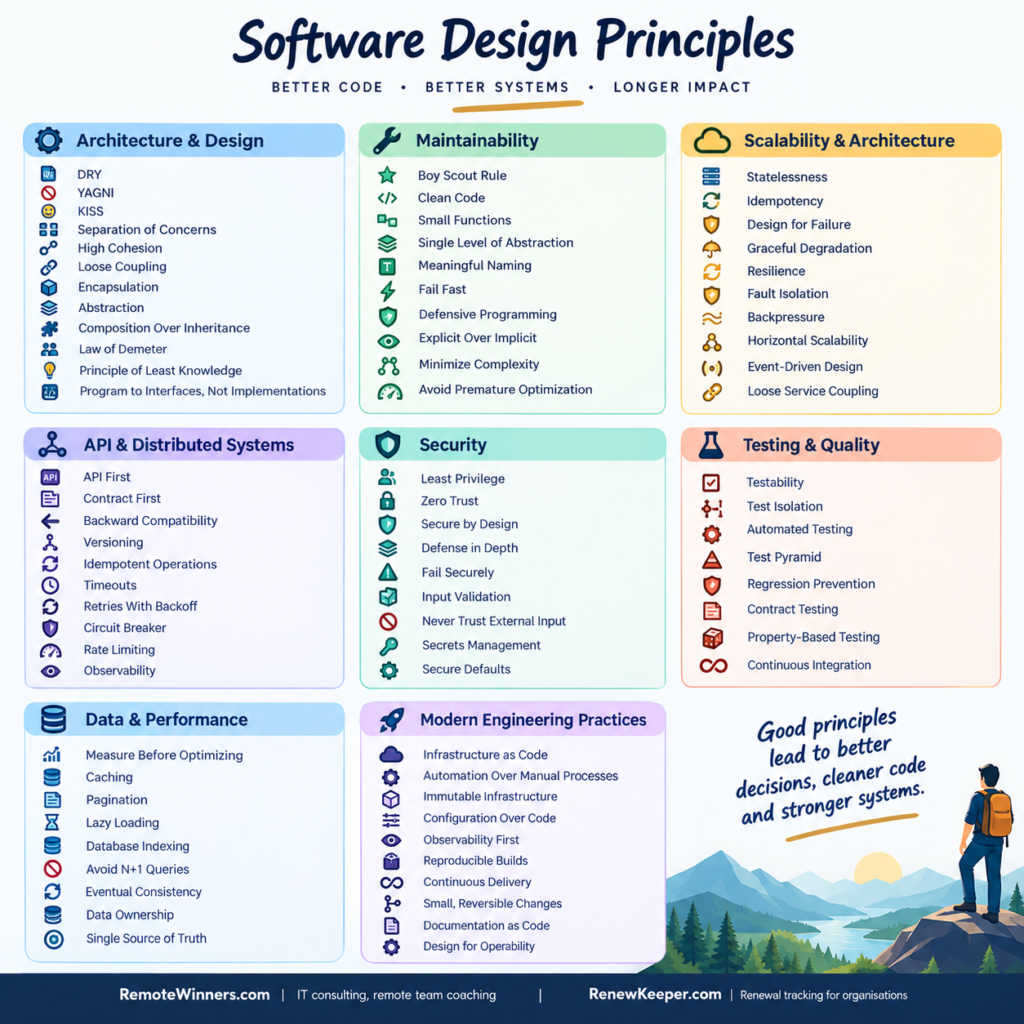
1. Architecture and design
These are the foundations. Get them right and everything else becomes easier to build on.
- DRY: Avoid duplicating logic so changes only need to be made in one place.
- YAGNI: Don’t build functionality until there’s a real need for it.
- KISS: Prefer the simplest solution that effectively solves the problem.
- Separation of concerns: Keep different responsibilities and areas of logic independent.
- High cohesion: Keep closely related functionality together within the same component.
- Loose coupling: Minimise dependencies so components can evolve independently.
- Encapsulation: Hide internal implementation details and expose only what’s necessary.
- Abstraction: Expose what something does while hiding unnecessary detail.
- Composition over inheritance: Combine smaller components rather than building deep inheritance hierarchies.
- Law of Demeter: Talk to immediate collaborators rather than reaching through multiple layers.
- Principle of least knowledge: A component should know as little as possible about the internals of others.
- Program to interfaces, not implementations: Depend on contracts rather than concrete classes.
💡 From experience: DRY applied too early is one of the most common causes of tight coupling I see. Two pieces of code that look the same today may need to change for different reasons tomorrow.
2. Maintainability
Code is read far more often than it’s written. These principles are about the next person who opens the file, which is often future you.
- Boy Scout rule: Leave the code slightly better than you found it.
- Clean code: Write code another developer can easily understand and maintain.
- Small functions: Keep each function focused on one clear task.
- Single level of abstraction: Keep code within a function at a consistent level of detail.
- Meaningful naming: Use names that clearly communicate purpose.
- Fail fast: Detect and report problems as early as possible.
- Defensive programming: Anticipate invalid inputs and unexpected conditions.
- Explicit over implicit: Make important behaviour and dependencies visible.
- Minimise complexity: Reduce unnecessary branching, dependencies and layers.
- Avoid premature optimisation: Solve the real problem first, then optimise when measurements justify it.
3. Scalability and architecture
These principles decide whether your system copes with growth, or collapses under it.
- Statelessness: Keep services independent of stored session state so they scale easily.
- Idempotency: Repeating an operation should produce the same intended result.
- Design for failure: Assume components will fail and handle it safely.
- Graceful degradation: Keep essential features available when parts of the system fail.
- Resilience: Build systems that recover and keep operating.
- Fault isolation: Stop failures in one component spreading through the system.
- Backpressure: Control incoming work when consumers can’t keep up.
- Horizontal scalability: Scale by adding instances, not just bigger machines.
- Event-driven design: Use events to communicate changes and reduce direct dependencies.
- Loose service coupling: Let services evolve independently.
4. API and distributed systems
The moment two systems talk over a network, a whole new set of things can go wrong. These principles keep integrations predictable.
- API first: Design the API contract before building the implementation.
- Contract first: Agree inputs, outputs and behaviour between systems before development.
- Backward compatibility: Make changes without breaking existing consumers.
- Versioning: Provide controlled versions when contracts need to evolve.
- Idempotent operations: Ensure retries don’t create duplicate or inconsistent results.
- Timeouts: Never wait indefinitely on a dependent service.
- Retries with backoff: Retry temporary failures with increasing delays.
- Circuit breaker: Temporarily stop calling an unhealthy dependency to prevent cascading failures.
- Rate limiting: Control request volume to protect against overload and abuse.
- Observability: Make system behaviour understandable through logs, metrics and traces.
💡 From experience: Retries without idempotency are a bug waiting to happen. In payment systems especially, one retried request without an idempotency key can mean a customer charged twice.
5. Security
Security bolted on at the end is expensive and fragile. These principles build it in from day one.
- Least privilege: Give users, services and applications only the permissions they need.
- Zero trust: Never trust a user, device or service just because it’s inside the network.
- Secure by design: Consider security requirements from the start.
- Defence in depth: Use multiple layers of protection so one failure doesn’t expose everything.
- Fail securely: When something breaks, default to a safe, restricted state.
- Input validation: Validate external data before it influences behaviour.
- Never trust external input: Treat data from users and external systems as unsafe until validated.
- Secrets management: Store credentials, keys and tokens securely, never in code.
- Secure defaults: Make the safest configuration the default one.
6. Testing and quality
Tests are how you change code with confidence. Without them, every release is a gamble.
- Testability: Design components so behaviour can be tested easily and reliably.
- Test isolation: Keep tests independent of each other.
- Automated testing: Automate repeatable tests to catch regressions quickly.
- Test pyramid: Many fast unit tests, fewer integration tests, a small number of end-to-end tests.
- Regression prevention: Add safeguards so fixed problems don’t return.
- Contract testing: Verify services keep honouring their agreements.
- Property-based testing: Test general rules across many generated inputs.
- Continuous integration: Integrate changes frequently and verify them automatically.
7. Data and performance
Performance problems are usually data problems in disguise. These principles help you find and fix the right bottleneck.
- Measure before optimising: Use real measurements to find bottlenecks first.
- Caching: Reuse frequently accessed data to reduce computation and network calls.
- Pagination: Return large datasets in manageable portions.
- Lazy loading: Load resources only when they’re needed.
- Database indexing: Index frequently queried data for faster retrieval.
- Avoid N+1 queries: Don’t fire database queries inside loops.
- Eventual consistency: Accept that distributed data may briefly differ while systems converge.
- Data ownership: Define which component is responsible for each piece of data.
- Single source of truth: Keep authoritative information in one place.
8. Modern engineering practices
These principles turn good code into reliable delivery. They’re where engineering culture and tooling meet.
- Infrastructure as code: Define infrastructure in version-controlled configuration.
- Automation over manual processes: Automate repeatable work to reduce errors.
- Immutable infrastructure: Replace infrastructure rather than modifying it in place.
- Configuration over code: Control changeable behaviour through configuration.
- Observability first: Build monitoring and diagnostics in from the beginning.
- Reproducible builds: The same source and dependencies should always produce the same build.
- Continuous delivery: Keep software releasable through automated build, test and deployment.
- Small, reversible changes: Make changes small enough to understand, test and roll back.
- Documentation as code: Keep documentation close to the code and maintain it in the same workflow.
- Design for operability: Build systems that are easy to deploy, monitor and troubleshoot.
How to actually use these principles?
A list of 78 principles is only useful if it changes how you work. Here’s what I’d suggest:
- Recognise, don’t memorise. You don’t need to recite all 78. You need to notice when code is breaking one.
- Accept that principles conflict. YAGNI and design for failure pull in different directions. DRY and loose coupling can clash. Good engineering is choosing the right trade-off for the context.
- Name them in code reviews. “This breaks the Law of Demeter” is a clearer, less personal comment than “I don’t like this”.
- Pick a few per quarter as a team. Focus on two or three principles, bake them into your PR template or definition of done, then move on.
- Use them to challenge AI output. Before accepting generated code, ask which principles it follows and which it quietly ignores.
In a nutshell
Software design principles are the proven guidelines that make code easier to change, systems easier to scale, and products safer to run. For engineers, they’re the fastest route from writing code that works to making decisions that last. For CTOs and heads of engineering, they’re a shared language that scales good judgment across the whole team, including remote and distributed ones. And in an AI-assisted world, they matter more than ever, because knowing why code is good is now the skill that sets great engineers apart.
Frequently asked questions
What are software design principles?
Software design principles are guidelines such as DRY, KISS, separation of concerns and loose coupling that help engineers build software that’s maintainable, scalable, secure and testable. They focus on how code is structured rather than which language or framework it uses.
What are the most important software design principles for beginners?
Start with KISS, DRY, YAGNI, meaningful naming and separation of concerns. They apply to almost every piece of code you write and form the foundation for more advanced principles.
Are software design principles still relevant with AI coding tools?
Yes, arguably more so. AI can generate code quickly, but it doesn’t reliably judge whether that code is secure, maintainable or fit for your architecture. Engineers who understand the principles can review and improve AI output rather than simply accepting it.
How can a CTO embed design principles in an engineering team?
Build them into code review checklists, PR templates, architecture decision records and onboarding. Focus on a small number at a time, and have senior engineers model them in reviews rather than enforcing them as rigid rules.
What’s the difference between design principles and design patterns?
Principles are general guidelines about what good software looks like, such as loose coupling. Patterns are reusable solutions to specific problems, such as the circuit breaker or repository pattern, which usually exist to put principles into practice.
Want stronger engineering foundations in your team?
Whether you’re an engineer aiming for your next step up, or a founder or tech leader building a team that ships reliable software, I can help.
👉 Explore my consulting and coaching services
👉 Book a conversation